Fake offer and experience letters: how to verify (2026)
How fake job offers and forged experience letters work in India, the warning signs, where to report, and how to make your own letters easy to verify.

Fake letters hurt both sides of hiring. Job seekers receive offer letters from companies that never interviewed them, carrying a real company’s name and a request for money or personal details. Employers receive experience and relieving letters from companies the candidate never worked for, or for roles they never held.
This article explains how both problems work, the warning signs, where to report them, and how to make your own company’s letters easy for anyone to check. It is a practical guide, not legal advice.
1. Fake job offers: how the scam works
Government agencies have warned job seekers repeatedly about recruitment fraud:
- Fees, bank accounts and OTPs. CyberDost, the cyber safety initiative of the Indian Cyber Crime Coordination Centre (I4C), has advised job seekers to verify employers before accepting an offer, not to pay registration fees, and never to share bank information, Aadhaar details or OTPs with unknown recruiters. The same report describes fake remote jobs used to trick job seekers into opening bank accounts and handing over their cards and SIM cards to fraudsters.
- Fake interviews that capture biometrics. In May 2026, the Ministry of Home Affairs warned job seekers about fraudsters posing as recruiters who use video “verification”, such as facial recognition or eye scanning, to collect biometric data.
Warning signs in an offer letter
- A request for money: registration, training, security deposit or “document verification” fees.
- An offer without a real interview, or after a short chat on WhatsApp or Telegram.
- A personal email address or an unofficial domain instead of the company’s own.
- Pressure to decide or pay today.
- Requests for OTPs, bank cards, passbooks or biometric scans before you have joined.
- No way to check the letter with the company through its official website or phone number.
What a job seeker should do
- Find the company’s official website yourself and contact HR through the details given there, not those in the letter.
- Never pay to get a job, and never share OTPs, bank cards or biometrics with a recruiter.
- Report fraud on the national cybercrime helpline, 1930, available 24 hours a day, or on the National Cybercrime Reporting Portal at cybercrime.gov.in.
What an employer should do when its name is misused
- Publish a notice on your careers page: you never charge candidates a fee, and offers come only from your official email domain.
- Give candidates a way to check a letter, such as a verification code or a named HR contact.
- Report fake offers using your name on the cybercrime portal, and keep copies of what candidates send you.
2. Forged experience and relieving letters
The other side of the problem reaches HR directly: experience letters, relieving letters and payslips that are forged or altered to inflate a role, dates or salary.
It is a crime as well as a hiring risk. Under section 340 of the Bharatiya Nyaya Sanhita, 2023, whoever fraudulently or dishonestly uses as genuine a document or electronic record they know or have reason to believe is forged is punished as if they had forged it themselves.
How to check a letter from a previous employer
- Contact the previous employer through its official website or phone number, not the contact details printed on the letter.
- Compare the details: designation, dates and salary on the letter against payslips and the joiner’s provident fund records.
- Use the letter’s own verification, if it has a QR code or verification code, and check that the details match.
- Run background checks with the joiner’s consent, as our joining documents checklist explains.
- Record who checked what and when, so the decision rests on a record.
3. Make your own letters easy to verify
Every company that issues letters can make forgery harder and checking easier:
- Send letters only from your official email domain.
- Number every letter in a consistent series.
- Put a verification code or QR code on every page, linked to a page where anyone can confirm the letter is genuine.
- Issue signed PDFs, not editable documents.
- Keep a record of every letter issued, so you can answer a verification request in minutes.
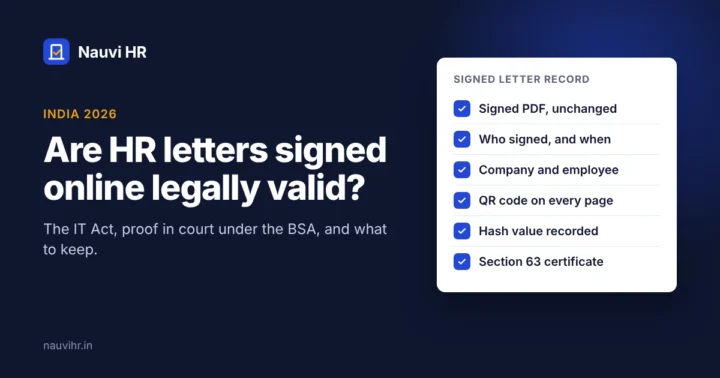
- Have letters signed by both sides online, with a record of who signed and when; our guide on whether HR letters signed online are legally valid explains what to keep.
Letters anyone can check, in Nauvi HR
Nauvi HR builds verification into every letter, so candidates, future employers and anyone else can check it without contacting you:
- Every page of a signed letter carries a QR code and a verification code (HR letters).
- Anyone can check on the public verification page that the letter is genuine and unchanged.
- Letters are numbered and signed online by your authorised signatory and the employee, each with a one-time code.
- If you withdraw a letter, the employee is told by email.
- Temporary ID cards carry a QR code too, showing whether a card is active, expired or revoked (temporary ID cards).
- Every company account is verified, and joiners see a Verified employer badge once it is.
Frequently asked questions
How can I check if an offer letter is genuine?
Find the company’s official website yourself and contact its HR team through the details given there. If the letter has a QR code or verification code, check it on the company’s or provider’s official verification page. Be suspicious of any request for money.
Does a genuine company ask for a fee before joining?
Government advisories tell job seekers not to pay registration fees to get a job. Treat any request for a fee, deposit or charge as a warning sign.
What should we do if someone is sending fake offers in our company’s name?
Publish a notice on your careers page, tell candidates how to verify a letter, and report the fake offers on the National Cybercrime Reporting Portal at cybercrime.gov.in or helpline 1930.
Is using a fake experience letter a crime?
Yes. Under section 340 of the Bharatiya Nyaya Sanhita, using a document or electronic record as genuine while knowing it is forged is punished as if the person had forged it.
References
Sources, all checked on 17 November 2026.
- The Week: CyberDost advisory on fake job offers, August 2026
- The CSR Journal: Ministry of Home Affairs warning on biometric job scams, May 2026
- Kerala Police: National Cybercrime Reporting Helpline 1930 and portal
- Vidhi Judicial: section 340 of the Bharatiya Nyaya Sanhita, 2023
This article is a practical guide, not legal advice.