Appointment letter format under the new labour codes (2026)
Appointment letters are now mandatory in India. What the OSH Code and rules require, the prescribed format, and how it differs from an offer letter.
Until recently, many Indian companies hired on an offer letter and an email. That is no longer enough. Since the labour codes came into force on 21 November 2025, every worker must be given an appointment letter, and the rules now set out what it must say.
This article explains what the law requires, what the prescribed format contains, how it differs from an offer letter, and the mistakes to avoid. It is a practical guide, not legal advice; check the rules of your state and industry with your advisor.
1. What the law says
- Every employee gets a letter on appointment. Section 6(1)(f) of the Occupational Safety, Health and Working Conditions Code, 2020 (the OSH Code) requires every employer to issue a letter of appointment to every employee on his appointment, with the information and in the form the government prescribes.
- Existing employees without a letter were due one within three months of the Code coming into force, so by February 2026. If any of your current employees still has no appointment letter, issue one now.
- No letter, no employment. The Occupational Safety, Health and Working Conditions (Central) Rules, 2026, notified on 8 May 2026, say that no employee shall be employed in any establishment unless an appointment letter has been issued in the prescribed format. The rule sets no minimum company size.
Central rules or state rules?
Which format applies depends on which government regulates your establishment. The Central Rules apply where the central government is the appropriate government, which typically includes public sector undertakings, railways, mines, ports, and banking and insurance. Most private companies follow their state’s rules.
States are at different stages. As of 1 October 2026, nine states and union territories had notified final OSH rules: Andhra Pradesh, Arunachal Pradesh, Bihar, Gujarat, Jammu and Kashmir, Ladakh, Lakshadweep, Rajasthan and Uttar Pradesh. Their formats are similar but not identical. Gujarat’s format, for example, also asks for prospects for higher wages or position and health check-up details, and Andhra Pradesh adds welfare board registration numbers.
If your state has not notified final rules yet, ask your advisor which format to follow. The central format below is a sound starting point, because it covers the items the other formats share.
2. What the letter must contain
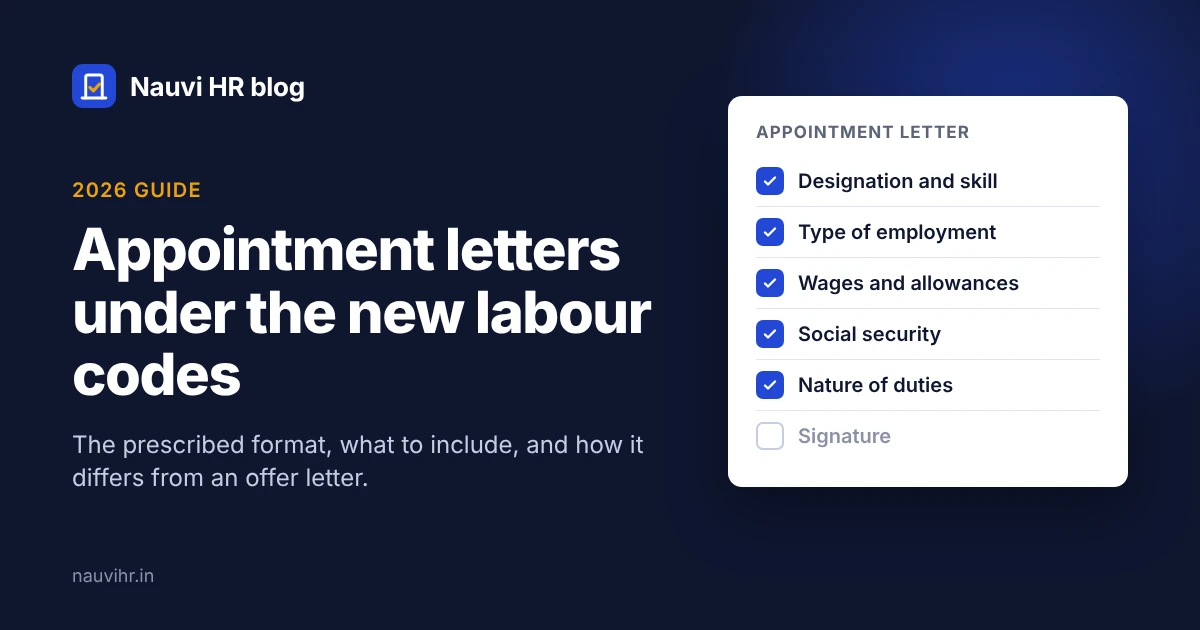
Rule 6 of the Central Rules sets out this format. Every item is a heading the letter must fill in:
- Name of employee
- Date of birth
- Father’s or mother’s name
- Aadhaar number, after obtaining consent
- Labour Identification Number of the establishment
- Universal Account Number and / or ESI insurance number, if available
- Designation
- Type of employment: regular, fixed-term or contractual
- Category of skill
- Date of joining
- Wages: basic pay and dearness allowance
- Other allowances, including accommodation, where applicable
- Applicability of social security benefits (provident fund and ESIC)
- Broad nature of duties
- Maternity benefits under the Code on Social Security, 2020, for women employees
- Any other information
The format ends with the signature or digital signature of the employer.
Two items need care:
- Aadhaar number. The format asks for it only after the employee consents. If the employee does not consent, leave it out; private employers cannot insist on Aadhaar. Our joining documents checklist explains why.
- Type of employment. For a fixed-term employee, state the end date as well. Fixed-term employees get the same benefits as permanent staff and gratuity after one year.
3. Offer letter and appointment letter: the difference
| Offer letter | Appointment letter | |
|---|---|---|
| Purpose | Proposes the job | Confirms the appointment |
| When | Before the candidate accepts | On or before the joining date |
| Required by law | No | Yes, for every employee |
| Format | Your own | Prescribed by the central or state rules |
| Usually conditional on | Documents, verification, relieving | Nothing; the conditions should be met by now |
Most companies use both. The offer letter secures the candidate’s acceptance. The appointment letter records the final terms in the prescribed format, and must match what the offer promised.
4. Drafting checklist
- Use the format for your establishment: your state’s rules, or the Central Rules where they apply.
- Fill in every prescribed item. Write “not applicable” rather than leaving an item out, so it is clear the item was considered.
- Match the accepted offer: designation, wages, joining date and place of work.
- Add your own terms after the prescribed items, under “any other information” or as annexures: probation, notice period, working hours, leave, confidentiality and the policies the employee must follow. These are not in the prescribed list, but most companies include them.
- Sign it, by hand or with a digital signature, and get the employee’s acknowledgement.
- Keep the signed copy with the employee’s records, and give the employee a copy.
5. Common mistakes
- Treating the offer letter as the appointment letter. An offer letter in your own format does not follow the prescribed format.
- Leaving out the Labour Identification Number, UAN or ESI number. These items are in the format; fill them in where they apply.
- Issuing the letter weeks after joining. The rules say no employee shall be employed until the letter is issued.
- One template for every state. If you have offices in several states, check each state’s format.
- Forgetting existing employees. The three-month window for employees who had no letter ended in February 2026.
- No letter for fixed-term or contractual staff. The format covers regular, fixed-term and contractual employment alike.
Appointment letters in Nauvi HR
Nauvi HR prepares and signs appointment letters online, so a joiner never starts without one:
- Letters come from templates you can edit, so you set up your state’s format once and reuse it for every joiner. Editing a template that letters already use keeps the old version, so every issued letter shows exactly what was sent.
- HR enters the employee’s details and the letter is laid out on your letterhead.
- The company signs with a one-time code, and the employee reads and signs from their phone (HR letters).
- Every page carries a QR code, so anyone can check that a letter is genuine.
- Each employment type is set up separately, from permanent and fixed-term to freelance / gig worker (employee onboarding).
Frequently asked questions
Is an appointment letter mandatory for every employee?
Yes. The OSH Code requires a letter of appointment for every employee, and the Central Rules say no employee shall be employed until one has been issued in the prescribed format.
Do we need to issue letters to employees who joined before the labour codes?
Yes, if they never received one. The Code gave employers three months from 21 November 2025 to issue letters to such employees. If you missed it, issue them now.
Can the appointment letter be signed digitally?
The central format ends with the “signature / digital signature of employer”, so a digital signature is provided for.
Must the letter include the employee’s Aadhaar number?
The central format asks for it only after the employee consents. Without consent, leave it out.
Do freelancers need an appointment letter?
A freelancer is not an employee, so the appointment letter requirement does not apply. Use a signed contract and an NDA instead.
References
Primary sources, all checked on 17 November 2026.
- Ministry of Labour and Employment: the four labour codes come into force
- Occupational Safety, Health and Working Conditions Code, 2020: section 6
- Occupational Safety, Health and Working Conditions (Central) Rules, 2026, G.S.R. 345(E), 8 May 2026
- Gujarat Occupational Safety, Health and Working Conditions Rules, 2025
This article is a practical guide, not legal advice.